The Obscure Film Iceberg organizes films not by quality but by degree of inaccessibility — rights burial, cultural stranding, active suppression, or pure archival neglect. Films at the tip are known but hard to find. Films at the bottom are obscure primarily due to controversy, most often involving child actor exploitation. This piece attempts to verify every identifiable title across all seven layers.
Status markers: [+] confirmed real. [?] uncertain or unverifiable. [x] could not confirm.
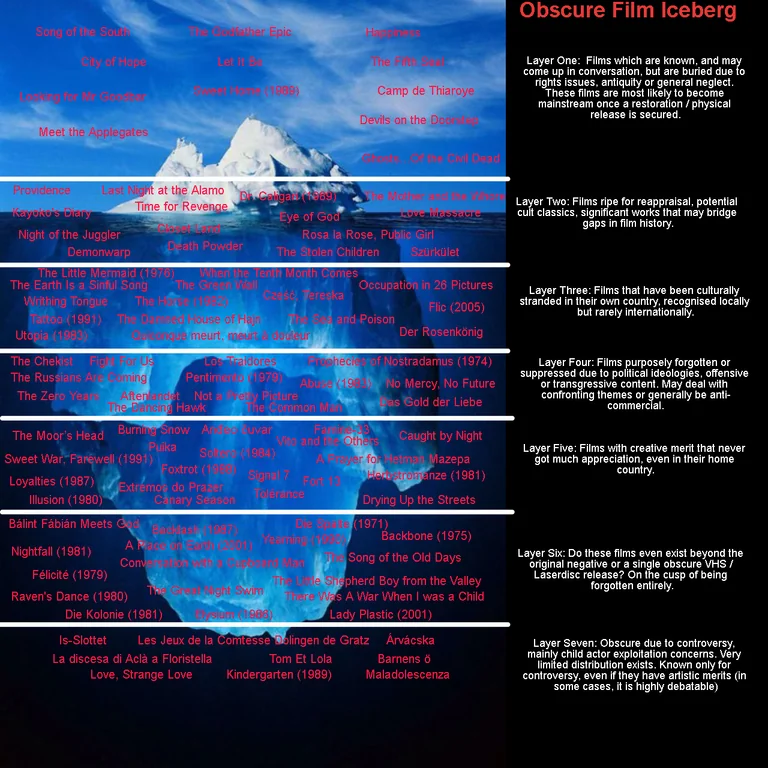
Layer 1 — Known, Buried by Rights, Antiquity, or Neglect
These films are most likely to resurface once a restoration or physical release is secured.
Song of the South (1946) [+]
Disney’s animated and live-action hybrid, deliberately vaulted for decades due to its racist depiction of antebellum plantation life. Never released on home video in the United States. It did see PAL VHS releases in the UK between 1982 and 2000, and VHS and LaserDisc editions in Japan in 1985, 1990, and 1992 — all international home video was withdrawn worldwide in December 2001. Bob Iger personally killed an internal plan to release the film on DVD circa 2005–2007 as part of the Walt Disney Treasures line, despite the home video department reportedly being eager to release it for the profit. Iger has confirmed it will never appear on Disney+. Tokyo Disneyland’s Splash Mountain remains operational as of 2025, facing less cultural pressure than its US counterparts, which were rethemed to Tiana’s Bayou Adventure in 2024. Wikipedia · Deadline
The Godfather Epic (1977) [+]
An extended, chronologically restructured television cut of The Godfather and The Godfather Part II, produced for NBC. The original 1977 broadcast, titled “The Godfather: A Novel for Television,” aired over four consecutive nights in November 1977 at approximately 434 minutes — about seven hours and fourteen minutes — incorporating roughly 75 minutes of deleted scenes not in the theatrical releases, though censored for broadcast standards. The home video version, “The Godfather: The Complete Epic 1901–1959,” was a separate, shorter edit at 386 minutes, cut down because NBC still held exclusive broadcast rights to the longer Saga cut. In 2008, a pristine copy of the original 1977 NBC print was discovered during sourcing for the Coppola Restoration project and re-matted to widescreen; the subsequent HBO version restores most of the removed material to approximately 423 minutes. CBR · Screen Rant
Happiness (1998) [+]
Todd Solondz’s dark suburban satire, featuring Dylan Baker as a pedophile. Originally acquired by October Films; its distributor’s parent company Universal refused to release it. Ultimately distributed independently. The film holds 84% on Rotten Tomatoes and 81 on Metacritic; Roger Ebert gave it four stars and ranked it fifth in his 1998 top ten. It won the FIPRESCI Prize at the 1998 Cannes Film Festival. For years it remained unavailable on any streaming service or for digital purchase, but the Criterion Collection released it on Blu-ray and 4K UHD on September 24, 2024 — its first proper physical release in years. IMDB · Criterion
City of Hope (1991) [+]
John Sayles ensemble film about urban politics and race in a New Jersey city. The film features a massive 52-role ensemble cast including Vincent Spano as Nick Rinaldi, Joe Morton as a frustrated city councilman, David Strathairn as a disturbed street person, Chris Cooper, Tony Lo Bianco, and Todd Graff. Set in a fictional New Jersey city, it was actually filmed in the Over-the-Rhine neighborhood of Cincinnati. Strathairn won the Independent Spirit Award for Best Supporting Male in 1992, the film took the Tokyo Grand Prix at the Tokyo International Film Festival, and Sayles won the Kansas City Film Critics Circle Award for Best Screenplay. Currently available for rental or purchase on Fandango at Home. IMDB · Roger Ebert
Let It Be (1970) [+]
Michael Lindsay-Hogg’s Beatles documentary, covering the January 1969 recording sessions and culminating in the rooftop concert. The film was completed by late 1969 but delayed until May 1970; by the time it opened, the Beatles had publicly broken up one month earlier, and audiences arrived grieving — which darkened perceptions of a film already seen as documenting dysfunction rather than artistry. The surviving Beatles actively suppressed any reissue for decades because they felt the film misrepresented their working relationship, making it the one item in their catalog Apple Corps wanted to bury rather than exploit. Peter Jackson’s Park Road Post Production performed a full restoration from the original 16mm negative using the same de-mixing audio technology from the “Get Back” series, and the restored film debuted exclusively on Disney+ on May 8, 2024 — the first time it had been viewable in over fifty years. Variety · Beatles Bible
The Fifth Seal (1976) [+]
Hungarian moral allegory by Zoltan Fabri. Set in Budapest in December 1944 during the Arrow Cross Party’s fascist reign, four friends debate a hypothetical posed by a watchmaker: would you rather live as a comfortable tyrant or a conscientious slave? When Arrow Cross officers arrest them for allegedly calling the party murderers, the men are forced to slap a dying partisan in the face to earn their freedom — turning the abstract moral question into a real one. Based on Ferenc Santa’s 1963 novel. Won the Golden Prize at the 10th Moscow International Film Festival and was entered into the 27th Berlin International Film Festival; also Hungary’s submission for the Best Foreign Language Film Oscar at the 49th Academy Awards, though not nominated. Widely considered one of the greatest Hungarian films ever made. Currently streamable on Klassiki, the Eastern European cinema streaming platform. Wikipedia · NFI Hungary
Looking for Mr. Goodbar (1977) [+]
Richard Brooks thriller starring Diane Keaton as a woman leading a dangerous double life. Based on Judith Rossner’s 1975 bestselling novel (over four million copies sold), which was inspired by the real 1973 murder of Roseann Quinn, a 28-year-old New York City schoolteacher stabbed to death by John Wayne Wilson, a man she met at a bar called Tweed’s on New Year’s night; Wilson hanged himself in jail before trial. The film grossed $22.5 million and earned Oscar nominations for Best Supporting Actress (Tuesday Weld) and Best Cinematography. It was unavailable on home media for nearly twenty years due to licensing complications with its extensive popular music soundtrack, but Vinegar Syndrome — under license from Paramount — finally released it on 4K UHD and standard Blu-ray on November 29, 2024, resolving the rights issues. Wikipedia · History.com
Sweet Home (1989) [+]
Japanese supernatural horror film directed by Kiyoshi Kurosawa, produced alongside a Famicom video game tie-in by Capcom. A TV crew enters the abandoned mansion of the painter Mamiya Ichiro to document his lost frescoes, only to be attacked by the ghost of his wife, who accidentally burned their child alive in the house’s furnace and now cannot rest. The film was produced by Juzo Itami (director of Tampopo), and the practical special effects were done by legendary American makeup effects artist Dick Smith, featuring inventive set pieces including a twelve-foot multi-headed ghost shooting lightning. The Famicom game was designed by Tokuro Fujiwara, and when Capcom lost the rights to the Sweet Home name, designer Shinji Mikami retooled the planned remake into what became Resident Evil (1996) — directly inheriting Sweet Home’s mansion setting, limited inventory system, item-based door puzzles, and survival horror structure. Wikipedia · Midnight Eye
Camp de Thiaroye (1988) [+]
Senegalese co-production by Ousmane Sembene and Thierno Faty Sow. Depicts the Thiaroye massacre of November 30–December 1, 1944, in which French forces killed hundreds of West African tirailleurs (colonial soldiers freshly returned from WWII) for demanding their promised but unpaid wages. Won the Special Jury Prize at Venice 1988. Banned from distribution in France upon release, it was not available there until a DVD release in 2005. The film received a 4K DCP restoration through the African Film Heritage Project (a collaboration between The Film Foundation’s World Cinema Project, FEPACI, and UNESCO, in partnership with Cineteca di Bologna), and this restored version was screened at the 2024 Cannes Film Festival in the Cannes Classics section — 36 years after its French censorship — with further screenings at the New York Film Festival in 2025. Cannes Festival · Film at Lincoln Center
Meet the Applegates (1990) [+]
Dark comedy by Michael Lehmann about a family of insects disguised as suburban Americans, with the goal of accessing nuclear resources. The cast includes Ed Begley Jr., Stockard Channing, and Dabney Coleman. The film shares significant DNA with Heathers: director Michael Lehmann, writer Redmond, actor Glenn Shadix, three of the four producers (including Denise Di Novi), and multiple crew members all came from Heathers. Completed in 1988–89, it was shelved until February 1991 due to the financial collapse of its production company New World Pictures; it opened to just $274,815 and grossed only $485,772 total domestically against a $5 million budget — a commercial disaster that effectively stalled the Heathers team’s momentum. Wikipedia · Box Office Mojo
Devils on the Doorstep (2000) [+]
Jiang Wen’s black-and-white wartime black comedy. A Chinese villager is forced to house a Japanese soldier. Won the Grand Prix at Cannes 2000; subsequently banned in China. The ban resulted from two converging offenses: Jiang Wen submitted the film to Cannes without the Chinese Film Bureau’s permission (the Bureau sent officials to Cannes trying to prevent the screening), and the film’s content showed Chinese villagers treating a Japanese prisoner “as close as brothers” rather than with patriotic hatred, which authorities deemed a humiliation of the Chinese people. The punishment was severe: Jiang was banned from directing, producing, or appearing in film and television for seven years. The cast includes Jiang himself alongside Japanese actors Teruyuki Kagawa and Kenya Sawada. Wikipedia · Screen Daily
Ghosts… of the Civil Dead (1988) [+]
John Hillcoat’s debut feature, co-written by Nick Cave. Australian prison drama about a privately run facility deliberately driven to riot. Nick Cave plays Maynard, a psychopathic inmate who screams obscenities, paints cell walls in his own blood, and delivers what reviewers describe as an “absolutely insane performance” — the role is essentially a human accelerant designed to destabilize the prison population. The script drew heavily on Jack Henry Abbott’s 1981 prison memoir In the Belly of the Beast, adopting both Abbott’s descriptions of how unaccountable prison systems dehumanize inmates and his disjointed narrative style; the writers also consulted with David Hale, a former guard at the notorious USP Marion in Illinois, and cast actual ex-prisoners in supporting roles for authenticity. The film launched the Hillcoat-Cave partnership: Cave went on to write the screenplay for Hillcoat’s The Proposition (2005), and Hillcoat’s career trajectory from Ghosts through The Proposition to The Road (2009) traces a consistent preoccupation with institutional violence and moral collapse in confined worlds that began here. Wikipedia · Senses of Cinema
Layer 2 — Ripe for Reappraisal, Potential Cult Classics
Providence (1977) [+]
Alain Resnais’s English-language film. John Gielgud plays a dying novelist whose imagination distorts his family. The full cast forms what Resnais called a “Schubertian quintet”: Gielgud, Dirk Bogarde, Ellen Burstyn, David Warner, and Elaine Stritch, with screenplay by David Mercer and score by Miklos Rozsa. The film swept the 1978 Cesar Awards with seven wins — Best Film, Best Director, Best Screenplay, Best Music, Best Editing, Best Cinematography (Sacha Vierny), and Best Production Design — a remarkable haul for an English-language film at the French awards. Critical reception was sharply divided by geography: the French press was overwhelmingly enthusiastic, while American critics were largely hostile; Vincent Canby called it a “disastrously ill-chosen comedy” in the New York Times, and John Simon deemed it “an unmitigated disaster.” Wikipedia · Moria Reviews
Last Night at the Alamo (1983) [+]
Eagle Pennell’s Texas indie about regulars at a Houston bar the night before it is demolished. Written and co-produced by Kim Henkel, who co-wrote The Texas Chain Saw Massacre (1974) with Tobe Hooper, and shot in black-and-white by Eric Alan Edwards (later DP of My Own Private Idaho). The film premiered at the 1983 New York Film Festival, screened at Telluride and Berlin, and won a Special Jury Prize at the 1984 US Film Festival (predecessor to Sundance). Pennell’s earlier film The Whole Shootin’ Match (1978) directly inspired Robert Redford to found the Sundance Film Festival, but Pennell’s alcoholism destroyed his career — he was intermittently homeless through the 1990s and drank himself to death on July 20, 2002, eight days before his 50th birthday. A 2016 restoration produced by Louis Black (SXSW founder), Watchmaker Films, and IFC, championed by Tarantino and Linklater, premiered at SXSW to sold-out audiences; AGFA now distributes the restored print theatrically. Wikipedia · Roger Ebert
Dr. Caligari (1989) [+]
Stephen Sayadian’s avant-garde erotic horror film, a loose quasi-sequel to the 1920 silent classic. Sayadian previously directed under the pseudonym “Rinse Dream,” making Cafe Flesh (1982) and Nightdreams (1981), pornographic films that crossed into surrealist art cinema; Dr. Caligari was his only non-pornographic work, deliberately targeting the midnight movie audience. The cast includes Madeleine Reynal as Dr. Caligari and Fox Harris (of Repo Man) as Dr. Avol; production designer William Maginnis created the film’s distinctive candy-colored expressionist sets. Sayadian exploited the 1988 WGA strike to secure production resources around Los Angeles that were otherwise unavailable due to the work stoppage. The film received a 4K UHD restoration from Mondo Macabro in 2023, with a limited edition of 2,000 copies that sold out during pre-order. Wikipedia · Genre Grinder
The Mother and the Whore (1973) [+]
Jean Eustache’s 3.5-hour French New Wave landmark. A three-way love story set in Paris cafes. Won the Special Jury Prize at Cannes 1973. The film is deeply autobiographical: Eustache based it on the collapse of his relationship with Catherine Garnier, and cast his real-life lover Francoise Lebrun as Veronika; after a private screening, Garnier killed herself, leaving a note reading “The film is sublime, leave it as it is.” Eustache shot himself in the heart with a revolver on November 5, 1981, at age 43, having made only one other feature (Mes Petites Amoureuses, 1974). The 2022 4K restoration was completed by Les Films du Losange, with support from CNC, Cinematheque Suisse, and Chanel, supervised by cinematographer Jacques Besse and Eustache’s son Boris; the physical work was done at L’Immagine Ritrovata and Eclair Classics from original 16mm A/B rolls. Criterion released the restoration on 4K UHD + Blu-ray. Wikipedia · Criterion
Eye of God (1997) [+]
Tim Blake Nelson’s Oklahoma noir about domestic violence and religious faith. The cast is stacked with future character-actor stars: Martha Plimpton as the lonely waitress, Kevin Anderson as the violent ex-convict pen pal she marries, a young Nick Stahl as the traumatized boy found covered in blood, Hal Holbrook as the small-town sheriff, plus Richard Jenkins, Margo Martindale, and Mary Kay Place. The film was nominated for the Grand Jury Prize at the 1997 Sundance Film Festival, won the American Independent Award at the Seattle International Film Festival, and took the Bronze Award at the 1997 Tokyo International Film Festival. Joel and Ethan Coen watched Eye of God as a favor to Nelson, liked it, helped with its editing, and subsequently sent Nelson the script for O Brother, Where Art Thou?, which launched his acting career. Wikipedia · IMDB
Love Massacre (1981) [+]
Patrick Tam’s Hong Kong drama. The plot follows college student Ivy (Brigitte Lin) who tries to help her friend Joy after a breakup, only to become entangled with Joy’s brother Chu Chung, who suffers from hereditary mental illness and spirals into a dormitory killing spree — the film shifts genres relentlessly from romance to thriller to full slasher. Tam mentored a young Wong Kar-wai, later directed Wong’s script for Final Victory (1987), and served as editor on both Days of Being Wild (1990) and Ashes of Time (1994); production/costume designer William Chang, who designed Love Massacre’s distinctive blue-red-black-white palette, became Wong Kar-wai’s career-long collaborator. M+ Museum in Hong Kong completed a 4K restoration in 2025, sourced from the original 35mm negative discovered that year plus a workprint at the Hong Kong Film Archive and a release print at UC Berkeley’s Pacific Film Archive. Asian Movie Pulse · M+ Museum
Closet Land (1991) [+]
Radha Bharadwaj’s two-character political torture drama. Alan Rickman and Madeleine Stowe are the only cast members. Set in a deliberately unnamed country to make the allegory universal: a children’s book author (Stowe) is abducted and tortured by a secret policeman (Rickman) who insists her fairy tale “Closet Land” contains encoded dissident messages. Bharadwaj was inspired by her husband’s work at Amnesty International; Amnesty executive Jack Healey personally brought the project to Ron Howard and Brian Grazer at Imagine Entertainment, who greenlit financing within ten days and gave Bharadwaj full creative control as a first-time director. A Universal Pictures release that quickly vanished. Wikipedia · Roger Ebert
Death Powder (1986) [+]
Japanese cyberpunk horror written and directed by folk singer Shigeru Izumiya. Three scientists steal a cybernetic android named Guernica and hide her in an abandoned warehouse; one researcher left to guard her is exposed to a substance she secretes (“death powder”) that causes hallucinatory body horror and reality dissolution. At 62 minutes, shot on what appears to be 8mm or low-grade video, the film opens with Blade Runner-esque neon noir aesthetics before collapsing into experimental montage of melting cityscapes, robotic imagery, and abstract body transformation. Credited as the first Japanese cyberpunk film, predating both Akira (1988) and Tetsuo: The Iron Man (1989); Arrow Films’ survey of Japanese cyberpunk cinema positions it as the origin point of the entire subgenre. Wikipedia · Arrow Films
The Stolen Children (1992) [+]
Gianni Amelio’s Italian road film (Il ladro di bambini). In Milan, 11-year-old Rosetta and her younger brother Luciano are seized by authorities after their mother is arrested for prostituting the girl; a young carabiniere named Antonio (Enrico Lo Verso) is assigned to escort them by train to a Catholic orphanage, and the reluctant journey south becomes a road movie about human decency. Amelio cast non-professional actors for nearly all roles, including both child leads (Valentina Scalici as Rosetta, Giuseppe Ieracitano as Luciano), and shot entirely on location — methods explicitly echoing Italian neorealism; the title itself deliberately evokes De Sica’s Ladri di biciclette. Won the Special Jury Prize at Cannes 1992. Submitted as Italy’s entry for Best Foreign Language Film at the 65th Academy Awards but not nominated. Currently holds 100% on Rotten Tomatoes. Wikipedia · Roger Ebert
Szurkuelet (1990) [+]
Hungarian slow-cinema drama by Gyorgy Feher (Twilight), based on Friedrich Dürrenmatt’s The Pledge (1958) — not Simenon, as often misattributed. Feher was 16 years Bela Tarr’s senior and was the older filmmaker’s key artistic influence: according to director Laszlo Nemes, Feher was instrumental in Tarr’s shift toward long-take contemplative cinema. Feher produced Satantango (1994), wrote dialogue for Werckmeister Harmonies (2000), and Tarr served as consultant on Szurkuelet itself, while cinematographer Miklos Gurban shot both Szurkuelet and Werckmeister Harmonies. The film premiered at the 43rd Locarno Film Festival where Gurban won the Bronze Leopard for cinematography. Essentially unavailable for decades until a 4K restoration by the National Film Institute Hungary; released on Region B Blu-ray by Second Run in 2023. Tarr made a short documentary, Gyorgy Feher’s Films According to Bela Tarr (2001), as tribute after Feher’s death. Wikipedia · IndieWire
Layer 3 — Culturally Stranded, Recognised Locally, Rarely International
The Little Mermaid (1976) [+]
Soviet-Bulgarian co-production (Rusalochka), directed by Vladimir Bychkov and adapted from the Hans Christian Andersen story. Despite common assumption, this is a live-action fantasy film, not animated, running 81 minutes. The mermaid exchanges her blue hair for legs rather than giving up her voice — a departure from Andersen’s original. Not the Disney version. Currently watchable with English subtitles on SovietMoviesOnline. IMDB · Letterboxd
When the Tenth Month Comes (1984) [+]
Dang Nhat Minh’s Vietnamese drama. The plot centers on Duyen, an actress in a theatrical troupe who discovers her husband was killed in battle a year earlier; she hides his death from his elderly father and her young son. The film’s supernatural centerpiece — a mystical ghost market where Duyen reunites with her husband’s spirit — was attacked by Vietnamese censors as “superstitious,” and director Dang Nhat Minh was subjected to thirteen rounds of censorship review before the scene was allowed in shortened form. Widely considered a masterpiece of Vietnamese cinema and the first Vietnamese film shown in the West after the Vietnam War. Recently screened at the 25th San Diego Asian Film Festival (2024). Asian Movie Pulse · SDAFF
The Earth Is a Sinful Song (1973) [+]
Finnish film (Maa on syntinen laulu) by Rauni Mollberg. Based on the novel by Timo K. Mukka, set in poverty-stricken western Lapland in the late 1940s, following 19-year-old Martta’s doomed affair with Oula, a womanizing reindeer herdsman; her pregnancy triggers a spiral of violence from her alcoholic father. Upon release it was the most widely attended film in Finnish history. Controversial for its frank sexuality; Finland’s submission for Best Foreign Language Film at the 46th Academy Awards. Wikipedia · Spectacle Theater
The Green Wall (1970) [+]
Peruvian film (La muralla verde) by Armando Robles Godoy. Based on Robles Godoy’s own experience abandoning Lima to “colonize” the Peruvian jungle in the 1960s, the film uses a non-sequential narrative with fluid crosscutting between past and present, layered with off-camera conversations and free-form sound design mixing rainfall, fire, and music. Roger Ebert gave it a rave review, comparing it to The Bicycle Thief and The Wild Child, and named it the 5th best film of 1972. Won the Golden Hugo and Critics’ Prize at the Chicago Film Festival. Only the fourth feature film ever made in Peru and the first to receive significant international distribution. Roger Ebert · IMDB
Occupation in 26 Pictures (1978) [+]
Yugoslav film (Okupacija u 26 slika) by Lordan Zafranovic. The first film in Zafranovic’s WWII trilogy, followed by The Fall of Italy (1981) and Evening Bells (1986), all co-written with Mirko Kovac. Set in Dubrovnik in 1941, it follows three friends — Miho (Jewish), Niko (Croat), and Toni (Italian) — whose bond is destroyed by fascism. A massive box office hit in Yugoslavia and Czechoslovakia. Won the Golden Arena for Best Film at Pula 1978 and screened at Cannes 1979. The film stirred controversy for its unflinching, non-ideological depictions of Ustasha violence and explicit sexuality, comparable in ambition to Visconti and Bertolucci. Wikipedia · MoMA
The Horse (1982) [+]
Turkish film (At) by Ali Ozgenturk. A father named Huseyin and his son Ferhat migrate from rural Turkey to Istanbul, where Huseyin buys a vegetable cart to earn money for his son’s schooling while Ferhat dreams of buying a horse. Without a license, Huseyin is hounded by police; after losing his cart and exhausting every option, he steals another cart and is beaten to death by its owner before he can sell a single flower. Ozgenturk was an assistant and screenwriter for Yilmaz Guney before directing his own work. The film screened at Cannes and won the Ozu Award at the Tokyo International Film Festival. Encyclopedia.com · IMDB
Czesc, Tereska (2001) [+]
Polish film by Robert Glinski about a young woman’s moral deterioration in a Warsaw housing project. Shot on DV in grainy black and white, the film follows Tereska, a teenager in Warsaw’s grim Soviet-era tower blocks who enrolls at a tailor school, falls under the influence of charismatic classmate Renata, and spirals into drinking, theft, and exploitation. Lead actress Aleksandra Gietner was cast from a reform school with no prior acting experience, delivering a performance widely praised as devastating. Won the Silver Bear at the Berlin International Film Festival, the Golden Lions at the Gdynia Polish Film Festival, four Polish Eagle awards (including Best Film and Best Director), and the FIPRESCI Prize “for its poignant portrayal of a young girl trying to survive in a dysfunctional society.” Culture.pl · FIPRESCI
The Sea and Poison (1986) [+]
Japanese film (Umi to dokuyaku) by Kei Kumai, based on Shusaku Endo’s novel about Japanese wartime medical experiments on American POWs — itself based on the real Kyushu Imperial University vivisection incident of 1945, in which eight downed American airmen were subjected to experimental surgery and killed. Stars Ken Watanabe as Toda (a cynical intern) and Eiji Okuda as Suguro (a conflicted young doctor). Shot entirely in black and white to increase moral starkness while lessening the gore of the graphic operation scenes. When Kumai pitched the project, every major studio rejected it as “dark, heavy, and difficult.” Won the Silver Bear at the 36th Berlin International Film Festival. Asian Movie Pulse · IMDB
Quiconque meurt, meurt a douleur (1998) [+]
Robert Morin’s radical Canadian experimental film (Whoever Dies, Dies in Pain). Shot in cinema verite/docufiction style, the film unfolds from the POV of a TV cameraman taken hostage during a botched police raid on a Montreal crack house. Over a 36-hour siege, the besieged addicts force the cameraman to record their stories. The cast are real ex-addicts who co-wrote the screenplay; Morin stated “they’re not just playing their own role, they’re creators at the same level as me.” Morin co-founded the Cooperative de Production Video de Montreal (Coop Video) in 1977 and is a central figure in Quebec experimental cinema. Almost never screened outside Quebec. Cinematheque quebecoise · Canadian Encyclopedia
Der Rosenkonig (1986) [+]
Werner Schroeter’s German film The Rose King. Set on a rose farm in Portugal, the film follows Anna (Magdalena Montezuma), a middle-aged rose grower, and her 25-year-old son Albert, who is obsessed with grafting roses and fixates on a young Italian man named Fernando not as a person but as an object, like his rose bushes. Montezuma, Schroeter’s lifelong muse and “alter ego,” was dying of cancer during the 1984 filming — everyone on set knew, and she reportedly wished to die on camera so it could be incorporated into the film. She died 14 days after shooting wrapped. A genuine arthouse work, very rarely screened. Available on the Internet Archive. Artforum · Senses of Cinema
The Damned House of Hajn (1988) [+]
Czech psychological horror/drama (Prokleti domu Hajnu) directed by Jiri Svoboda, based on Jaroslav Havlicek’s 1937 novel Neviditelny (“The Invisible Man”). The plot follows Sonya, heiress to a Czech noble family, whose husband Petr discovers an insane uncle who prowls the mansion believing himself invisible — the family indulges this delusion, and the uncle’s constant stalking destroys the young bride’s sanity. Previously listed as “The Damned House of Ham” — “Ham” is almost certainly a mistransliteration of “Hajn.” Letterboxd · MUBI
Utopia (1983) [+]
West German drama directed by Sohrab Shahid-Saless, an Iranian exile and pioneer of the Iranian New Wave who worked in German cinema after 1976. A grueling 3+ hour psychodrama about five women trapped in a brothel run by a sadistic pimp named Heinz (Manfred Zapatka). Entered into the 33rd Berlin International Film Festival and won the Television Prize of the German Academy of Performing Arts. Long considered a masterpiece of Shahid-Saless’s exile period. Wikipedia · IMDB
Layer 4 — Purposely Forgotten, Suppressed, or Anti-Commercial
The Chekist (1992) [+]
Aleksandr Rogozhkin’s Russian film depicting Cheka executions during the Russian Civil War. The film’s power comes from the mechanized repetition of its execution scenes: rows of men and women are stripped naked and lined up against blood-stained basement doors with their backs to a firing squad, over and over, as three Cheka officials read names and pronounce sentences in an office above. Based on a 1923 story by Vladimir Zazubrin — a story that remained unpublished until the Glasnost era, when it appeared in the journal Sibirskie Ogni in 1989; Zazubrin himself was arrested and executed in the Great Purge of 1937. Screened in Un Certain Regard at Cannes 1992. Has never received a legitimate Western home video release. Wikipedia · The Bedlam Files
Fight for Us (1989) [+]
Lino Brocka’s Filipino political thriller (Orapronobis). Stars Phillip Salvador as Jimmy Cordero, an ex-priest and former political detainee freed after the EDSA revolution, who encounters the Orapronobis, a vigilante death squad led by Commander Kontra (Bembol Roco). The film was based on real events under the Aquino regime, where government-sanctioned vigilante groups carried out 88 cases of salvaging (extrajudicial killing) and 36 massacres within seven months. Premiered at Cannes 1989; denounced by the Philippine government and denied a domestic theatrical release. Brocka was a lifelong activist who co-founded Concerned Artists of the Philippines and was arrested in 1985 at an anti-Marcos protest. He died on May 22, 1991, when his car struck a concrete utility pole on East Avenue in Quezon City, and was posthumously named a National Artist of the Philippines for Film. Wikipedia · Wikipedia (Brocka)
Los Traidores (1973) [+]
Argentine political film (The Traitors) by Raymundo Gleyzer, about a corrupt union leader. The only fiction film produced by Cine de la Base, the militant collective Gleyzer formed as “the cinematographic arm of the PRT-ERP.” It was never commercially released and was exhibited clandestinely in unions, factories, dining halls, and poor neighborhoods during the Lanusse dictatorship; it could not be publicly screened until democracy returned, and not until 1995 could it be seen in color. Digitally restored in 2016 by INCAA (Argentina’s National Film Institute) through conservation work done by Juana Sapire, Gleyzer’s widow. Gleyzer was kidnapped on May 27, 1976, taken to the El Vesubio detention camp, tortured, and remains disappeared. MoMA · Cine.ar
Prophecies of Nostradamus (1974) [+]
Toho disaster film (Nosutoradamusu no daiyogen) by Toshio Masuda. The specific scenes that caused outrage depict a New Guinea expedition encountering radiation-scarred cannibals feeding on a team member; associate director Yoshimitsu Banno (who later directed Godzilla vs. Hedorah) was responsible for the New Guinea sequence. Anti-nuclear and hibakusha (atomic bombing survivor) advocacy groups filed complaints with the Eirin Board (Japan’s film censorship authority), protesting that the mutant depictions were offensive to survivors. Toho issued a public apology, and after a 1980 Japanese television broadcast of the uncut version, the studio placed the film under a self-imposed ban that continues to this day — it has never received a DVD or Blu-ray release. A VHS rip of the theatrical cut leaked in the late 1990s and remains the only way to see the film. Known internationally only through a truncated US television edit titled The Last Days of Planet Earth. Wikipedia · Wikizilla
Pentimento (1979) [+]
Frans Zwartjes’s Dutch experimental film. Frans Zwartjes (1927–2017) did not begin filmmaking until age 41, having previously been a painter, sculptor, musician, and violin maker who played viola for the Dutch National Opera; Susan Sontag once praised him as “the most important experimental filmmaker of his time.” The film’s title is an art-historical term for a hidden image beneath a painting; Zwartjes connected his war experiences to his work in psychiatry to create a film about a woman subjected to degrading experiments in a facility run by a Japanese surgeon who had previously been involved in wartime torture. The feminist protests at screenings were severe — film screens were blotted, copies were destroyed, and in one incident a film projector was thrown out of a window. Zwartjes’ oeuvre comprises more than fifty films, many preserved by Eye Filmmuseum. Eye Filmmuseum · MUBI
Abuse (1983) [+]
Arthur J. Bressan Jr.’s American film. The film follows Thomas, a teenager hospitalized after being beaten and burned by his parents, who meets Larry, a gay documentary filmmaker; when Thomas discovers Larry is gay, his defensive wall crumbles and they begin a relationship. Bressan based the story on an episode in his own life. His broader career spanned documentary, narrative, and adult film: Gay USA (1977) — shot in one day across five cities by twenty-five camera operators — was the first American feature-length LGBT documentary. His final film, Buddies (1985), was the first American feature about the AIDS pandemic, scripted in five days and shot in nine on a $27,000 budget. Bressan died of AIDS-related illness on July 29, 1987, at age 44. Wikipedia · IndieWire
No Mercy, No Future (1981) [+]
Helma Sanders-Brahms’s West German film (Die Beruhrte). Stars Elisabeth Stepanek as Veronika Christoph, the schizophrenic daughter of uncaring bourgeois parents who has been institutionalized; the film follows her descent through Berlin’s margins. Won the British Film Institute Award. Sanders-Brahms (1940–2014) was one of the defining female voices of New German Cinema alongside Fassbinder, Herzog, and Wenders; her magnum opus Germany, Pale Mother (1980) — a semi-autobiographical film about her own mother’s wartime experience starring Eva Mattes — was so uncompromisingly feminist that its Berlin Film Festival premiere provoked demands for more “objective” historical accounts, and thirty minutes were excised from the film. Wikipedia · BFI
The Zero Years (2005) [+]
Nikos Nikolaidis’s final film. Greek dystopian drama depicting four sterilized prostitutes in sadomasochistic servitude within a government-run brothel under a totalitarian state. Nikolaidis (1939–2007) is now recognized as the “Godfather of the Greek Weird Wave”; the psychosexual DNA of his films is a clear precursor to Yorgos Lanthimos and other contemporary Greek filmmakers. His career included Morning Patrol (1987) — a post-apocalyptic noir where all dialogue is composed of excerpts from novels that have been adapted into films — and Singapore Sling (1990), his magnum opus and one of the 100 best cult films ever made. The Zero Years was nominated for the Gold Hugo at the Chicago International Film Festival. After completing it, Nikolaidis declared he would stop making films to focus on music; he died in 2007. Wikipedia · Ultra Dogme
Not a Pretty Picture (1976) [+]
Martha Coolidge’s semi-autobiographical American film about rape, blending documentary and fictional reenactment. The hybrid technique works on two planes simultaneously: scripted reenactment scenes of Coolidge’s rape at age sixteen (with Michele Manenti, herself a rape survivor, cast as the younger Coolidge) intercut with documentary footage of the adult Coolidge directing her cast in a New York loft, where they discuss consent, self-blame, and the ethics of re-creating trauma on camera. Francis Ford Coppola was so impressed by the film that he invited Coolidge to work with American Zoetrope, which led directly to her directing Valley Girl (1983) and Real Genius (1985). In 2002 she became the first woman elected president of the Directors Guild of America in its 66-year history. The film received a new 4K digital restoration from the 16mm negative, supervised by Coolidge, and was released by the Criterion Collection in August 2024. Criterion · Filmmaker Magazine
The Russians Are Coming (1968/1987) [+]
DEFA (East German) film by Heiner Carow — not the 1966 American comedy. Carow’s semi-autobiographical film about a teenager who still believed in military victory in spring 1945 was completed in 1968 but banned by East German officials who argued it focused on an ordinary Nazi follower rather than an antifascist hero and was “contaminated with modernism.” Most of the original negative was destroyed; some footage was reused for flashback scenes in Carow’s Career (1971). The film was thought lost until Carow’s wife, editor Evelyn Carow, found a surviving positive print and helped reconstruct it. By 1987, the GDR climate had shifted enough to allow screenings, and the reconstructed film won Carow the Best Director award at the GDR National Feature Film Festival. Available to stream on Kanopy. DEFA Film Library · MoMA
Aftenlandet (1977) [+]
Danish dystopian docudrama (Evening Land) by Peter Watkins — previously listed as “Afterlandet,” almost certainly a misspelling. The film depicts a political crisis in Denmark: workers at the Copenhagen Shipyard strike after discovering they are building four nuclear-armed submarines for the French Navy; a government minister is kidnapped by radicals; and the state cracks down violently on the left during a NATO summit. Shot with 192 non-professional actors using improvised dialogue in Watkins’ signature docudrama style. It screened at Cannes, Edinburgh, and Moscow (where it was nominated for the Golden Prize), but the Scandinavian reception was hostile — Danish television refused to air it, claiming it did not “reach a standard which DR finds necessary.” This rejection caused Watkins to begin another period of self-exile from Scandinavia. Wikipedia · Peter Watkins
Das Gold der Liebe (1983) [+]
Directed by Eckhart Schmidt, who considered it the middle film of a trilogy beginning with Der Fan (1982) and ending with Loft (1985). Stars Alexandra and Allegra Curtis — the daughters of Tony Curtis and Christine Kaufmann — as Patricia, a young woman who fails to get into a D.A.F. concert and ends up witnessing a murder, sending her on the run through Vienna’s nightlife. Inspired by punk, Neue Deutsche Welle, and neon aesthetics, it was shot in a reported ten consecutive nights on a low budget. The film’s near-total obscurity is due to unresolved music rights; its sole home video appearance was a long-out-of-print German VHS. Letterboxd · Viennale
Dupont Lajoie (1975) [+]
French film by Yves Boisset, released in the US as The Common Man (also as Rape of Innocence) — previously listed under that English title. Jean Carmet stars as Georges Lajoie, a cafe owner on holiday in southern France who rapes and kills a young woman (an early role for Isabelle Huppert) and dumps her body near a construction site where Arab immigrant workers are employed, triggering a racist mob lynching of innocent workers. Based on real racist murders in Marseille in the early 1970s. Production was actively sabotaged by the far-right Charles Martel Group, which stoned the set and threw grenades and Molotov cocktails at the campsite filming location; actor Abderrhamane Benkloua, playing an Arab victim, was hospitalized after being attacked by four people in Toulon. Won the Silver Bear Grand Jury Prize at the 1975 Berlin Film Festival and drew approximately 1.5 million admissions in France. Wikipedia · Unifrance
Layer 5 — Creative Merit, No Appreciation Even at Home
Famine 33 (1991) [+]
Ukrainian film (Holod-33) by Oles Yanchuk, depicting the Holodomor, the Soviet-engineered famine that killed millions of Ukrainians. One of the first major Ukrainian films produced after Ukraine declared independence in August 1991, making it a landmark of post-Soviet Ukrainian cinema. Produced by the Dovzhenko Film Studios in Kyiv. The Holodomor had been entirely suppressed as a topic under Soviet rule; its production was only possible because of glasnost and then independence. Reception in Russia was predictably cold, as the film directly implicated Soviet policy, while in Ukraine it became an important cultural document. IMDB
Vito and the Others (1991) [+]
Italian film (Vito e gli altri) by Antonio Capuano, about street children in Naples. Capuano is a Neapolitan director who became one of the key figures of what critics called the “New Neapolitan Cinema” alongside Mario Martone and Pappi Corsicato. This debut film used non-professional actors — actual street children from the Quartieri Spagnoli and Forcella neighborhoods of Naples — placing it firmly in the Italian neorealist tradition of De Sica’s Shoeshine (1946). Capuano went on to direct several more films exploring Naples’ margins, including Pianese Nunzio, 14 anni a maggio (1996), which also dealt with difficult subjects involving Neapolitan youth. IMDB
A Prayer for Hetman Mazepa (2002) [+]
Ukrainian epic by Yuri Ilyenko, over three hours long. About the 17th–18th century Cossack hetman Ivan Mazepa and his complex relationship with Peter the Great. Ilyenko was the cinematographer on Sergei Parajanov’s masterpiece Shadows of Forgotten Ancestors (1965), and his own directorial work carried forward that tradition of highly stylized, painterly, almost hallucinatory visual composition. A Prayer for Hetman Mazepa was reportedly one of the most expensive Ukrainian films produced at that time, and its maximalist visual style — mixing periods, surreal imagery, and operatic staging — divided critics sharply between those who found it visionary and those who found it incoherent. Ilyenko (1936–2010) had a long career in Ukrainian cinema as both cinematographer and director, and this was essentially his final major work. Extremely rarely seen outside Ukraine. IMDB
Signal 7 (1983) [+]
Rob Nilsson’s American indie about San Francisco cab drivers. Nilsson co-founded the independent San Francisco collective “Cine Manifest” in the 1970s, which sought to create politically engaged, community-based cinema outside the Hollywood system. Signal 7 was a pioneering work in that it was one of the first dramatic features shot entirely on video (3/4-inch U-matic tape) and then transferred to 35mm film for theatrical projection — a workflow that was radical for 1983. The film used improvisational techniques drawn from both John Cassavetes’ methods and Direct Cinema documentary traditions; the cab driver actors largely developed their own scenes. Won the Grand Prize at the Mannheim Film Festival. Nilsson continued making low-budget, community-rooted features in San Francisco for decades, including Heat and Sunlight (1987), which won the Grand Jury Prize at Sundance. IMDB
Loyalties (1987) [+]
Canadian film by Anne Wheeler, one of Canada’s most significant women filmmakers. Stars Tantoo Cardinal — one of the most prominent Indigenous actresses in Canadian cinema — as Rosanne Ladouceur, a Métis woman, alongside Susan Wooldridge as a British doctor’s wife newly arrived in the Alberta town of Lac La Biche. The film examines the collision of race, class, and sexual abuse in a small community, and is notable for treating its Indigenous characters with complexity rather than as background figures. Wheeler’s other notable films include Bye Bye Blues (1989) and The War Between Us (1995). IMDB
Drying Up the Streets (1978) [+]
Canadian drama-documentary by Robin Spry about runaway youth on the streets of Toronto. Spry was a filmmaker associated with the National Film Board of Canada (NFB) who directed several socially engaged documentary and drama-documentary works. The film sits at the intersection of social documentary and exploitation cinema that characterized several Canadian urban films of the late 1970s — the debate around it was whether the gritty depiction of street life served a documentary/awareness purpose or veered into sensationalism. Genuinely disturbing; rarely seen today. IMDB
The Moor’s Head [x]
Could not identify a specific film matching this title. Possibly La testa del moro or a reference to the Sardinian/Corsican heraldic symbol.
Foxtrot (1988) [?]
Several films share this title. The most notable from roughly this era is Foxtrot (1976), a Mexican-British-Swiss co-production directed by Arturo Ripstein starring Peter O’Toole and Charlotte Rampling. A 1988 film of this title is harder to identify. Cannot confirm which is intended without further context.
Fort 13 [x]
Could not confirm from available sources.
Herbstromanze (1981) [x]
The German title translates to “Autumn Romance.” Likely an East German (DEFA) or West German television film. Could not confirm director or details.
Canary Season [x]
Could not confirm from available sources. Possibly a translation of a non-English title.
Illusion (1980) [?]
Multiple films share this title. Possibly a Yugoslav film (Iluzija) from this period. Cannot confirm without further context.
Layer 6 — On the Cusp of Being Forgotten Entirely
Balint Fabian Meets God (1980) [+]
Hungarian epic by Zoltan Fabri, depicting a peasant’s life between the World Wars. Fabri was one of the most important Hungarian filmmakers of the postwar era, whose career spanned from the 1950s through the 1980s — his best-known works include Merry-Go-Round (1956) and The Fifth Seal (1976), the latter often considered his masterpiece. Balint Fabian Meets God is a literary adaptation consistent with his focus on ordinary people caught in historical currents. Available on DVD in Hungary with English subtitles. Screened at the Cleveland International Film Festival. Cleveland IFF
Backlash (1987) [+]
Australian road film by Bill Bennett. Stars David Argue as a racist police officer tasked with transporting an Aboriginal woman (Lydia Miller) across the Outback, and the journey forces a confrontation with his prejudices. It fits into a small but notable strand of Australian outback thriller/road films that engage with racial tensions. Bennett went on to direct more commercially successful Australian films including Kiss or Kill (1997), probably his best-known work internationally. Very rarely seen outside Australia. IMDB
Die Kolonie (1981) [+]
East German film (The Colony) by Horst E. Brandt, about a murder in South America traced to a mysterious German farm. Loosely based on Colonia Dignidad — the secretive German cult colony in Chile run by Paul Schäfer. A DEFA (Deutsche Film-Aktiengesellschaft) production — DEFA being the state-owned film studio of the German Democratic Republic that operated from 1946 to 1992. A film about Colonia Dignidad would have been politically convenient for East Germany, as it could criticize West German complicity (many colonists came from West Germany) and fascist continuities in the West. IMDB
Elysium (1986/87) [+]
Hungarian Holocaust drama by Erika Szanto. A Jewish family’s young son is taken to a deportation camp that presents itself as paradise. Hungarian Holocaust cinema of the 1980s existed in a particular context: the Kádár regime had largely avoided direct confrontation with Hungarian complicity in the Holocaust, so films addressing this were navigating political sensitivities. IMDB
Lady Plastic (2001) [+]
A film about a director attempting to complete a cursed, unfinished production in order to resurrect its lead actress. On IMDB; very little further information publicly available. IMDB
Raven’s Dance (1980) [+]
Finnish film (Korpinpolska) by Markku Lehmuskallio, about a married couple and an elderly man in a remote part of Finland. Lehmuskallio is a Finnish filmmaker who has spent much of his career documenting the lives of indigenous and Arctic peoples, including the Sami of northern Scandinavia, the Nenets of Siberia, and other circumpolar communities. His work is ethnographic in spirit but artistic in execution, often blending documentary and fiction. He frequently collaborated with Anastasia Lapsui, a Nenets filmmaker, on later works documenting Siberian indigenous peoples. His filmography represents one of the most sustained cinematic engagements with Arctic indigenous cultures in European cinema. Letterboxd
Die Spalte (1971) [x]
A West German or Austrian film. Could not find verified information. May be one of those films that exists only as a single surviving print — which is, in fact, exactly what Layer 6 claims.
Nightfall (1981) [?]
Multiple films share this title; cannot confirm which is intended.
Felicite (1979) [?]
Note: not the well-regarded 2017 Alain Gomis film. Possibly a French adaptation of Flaubert’s short story Un coeur simple, whose protagonist is the servant Félicité — there have been several adaptations of that story, and a 1979 version may be a French television production. Could not confirm.
There Was a War When I Was a Child [x]
Could not confirm from available sources. The title suggests an Eastern European film about WWII from a child’s perspective — a common subject in that region’s cinema.
The Great Night Swim [x]
Could not confirm from available sources.
Layer 7 — Obscure Due to Child Actor Exploitation Concerns
All films in this layer are real and documented. They appear here not necessarily because of artistic failure but because they involve underage nudity, simulated sexuality, or child actor exploitation concerns that complicate or prevent distribution in many jurisdictions.
Is-Slottet (1987) [+]
Norwegian drama (The Ice Palace) by Per Blom, based on Tarjei Vesaas’s 1963 novel. Vesaas’s Is-Slottet is widely regarded as one of the masterpieces of Norwegian literature and Scandinavian modernism; it won the Nordic Council’s Literature Prize in 1964, one of the most prestigious literary awards in Scandinavia. Two twelve-year-old girls form an intense relationship; one disappears into a frozen landscape. The novel’s central mystery operates on a symbolic/psychological level rather than a literally supernatural one, and Per Blom’s film preserves this ambiguity, using the ice formations as visual metaphor for emotional isolation. Selected as Norway’s submission for Best Foreign Language Film at the 61st Academy Awards. The film was generally well-received in Norway as a respectful adaptation of a beloved national text. Contains brief nude scenes involving child actors. Released on Blu-Ray in Norway in 2024 by Norwegian Film Classics. Wikipedia · Norwegian Film Institute
Les Jeux de la Comtesse Dolingen de Gratz (1981) [+]
French fantasy-drama written and directed by Catherine Binet. Stars Carol Kane and Michael Lonsdale. Binet was the partner of Guy Debord, the Situationist theorist, and the film’s anti-narrative strategies owe a clear debt to Debord’s Situationist cinema. It blends elements from Bram Stoker’s Dracula with the writings and drawings of Unica Zürn, the German-born surrealist artist who suffered from mental illness and died by suicide in 1970; the result is a deliberately disorienting, non-linear vampire film more concerned with female psychic dissolution than genre thrills. Its near-total absence from distribution is attributable to its extreme formal difficulty, lack of commercial appeal, and the fact that Binet directed very few films — this was essentially her only feature — leaving no established distribution relationships or auteur reputation to sustain it in circulation. Barely distributed outside France. Wikipedia · MoMA (Unica Zürn)
Arvacska (1976) [+]
Hungarian drama (Nobody’s Daughter) by Laszlo Ranody, based on Zsigmond Moricz’s novel. The source novel Árvácska (1941) is considered one of the most devastating works in Hungarian literature — Moricz, often called the Hungarian Zola, based it on a real case he investigated of a foster child subjected to systematic abuse by a peasant family, and the novel is assigned reading in Hungarian schools to this day. Ranody was a veteran of Hungarian cinema who had previously adapted another major Moricz work, Légy jó mindhalálig (Be Good Until Death, 1960). The child actress Zsuzsa Czinkóczi, approximately 10 years old during filming, delivered a performance widely praised in Hungarian critical circles for its raw naturalism and went on to appear in several other Hungarian films in the late 1970s and 1980s. Available on DVD in Hungary with English subtitles. Rarefilmm
La discesa di Acla a Floristella (1992) [+]
Italian film by Aurelio Grimaldi, set in 1930s Sicily. Depicts the enslavement of a twelve-year-old boy sold to work in a sulfur mine. The carusi system was a form of de facto child slavery in Sicilian sulfur mines that persisted from roughly the early 19th century until the mines’ decline in the early 20th century; families would essentially sell boys as young as 7 to mine bosses (picconieri) under a loan/indenture arrangement, and the children suffered appalling conditions including physical and sexual abuse — the practice was documented by Italian social reformers and referenced in Booker T. Washington’s 1910 essay comparing it to American slavery. Grimaldi is a Sicilian writer-director whose work consistently focuses on social marginalization in Southern Italy. Grimaldi’s debut feature; a serious historical drama. TMDB
Tom et Lola (1990) [+]
French drama by Bertrand Arthuys, about two immunodeficient children living in sealed plastic bubbles. The film draws on the real medical condition of Severe Combined Immunodeficiency (SCID), most famously associated with David Vetter, the “Bubble Boy” of Houston, Texas, who lived in a sterile plastic isolator from 1971 until his death in 1984 at age 12 after a failed bone marrow transplant. Arthuys uses the bubble/isolator as both a literal medical setting and a metaphor for childhood’s fragile enclosure from the adult world. Critical reception in France was modest, with reviewers noting the film’s visual inventiveness and fairy-tale quality but questioning whether it fully reconciled its whimsical tone with the gravity of the medical premise. Released theatrically in France in January 1990; distributed in Switzerland and Japan. Wikipedia
Barnens o (1980) [+]
Swedish drama (Children’s Island) directed by Kay Pollak — who would later gain international recognition for Så som i himmelen (As It Is in Heaven), Sweden’s 2004 Oscar submission — based on P.C. Jersild’s 1976 bestselling novel. The story follows a 10-year-old boy who evades summer camp to spend weeks alone in Stockholm, and his unsupervised wanderings lead to encounters with adult sexuality, prostitution, and death. The novel and film were controversial in Sweden for their frank depiction of a child’s premature exposure to the adult world, though they were also defended as serious explorations of loneliness and the failure of parental responsibility. Jean Michel Jarre’s electronic score (one of his few film commissions) gives the film an eerie, dissociative atmosphere that reinforces the boy’s alienated perspective on the city around him. Swedish Film Institute · IMDB
Love, Strange Love (1982) [+]
Brazilian erotic drama (Amor Estranho Amor) by Walter Hugo Khouri. Khouri was one of Brazil’s most prolific art-house directors, active from the late 1950s through the 2000s, often described as the Brazilian Antonioni for his existentialist explorations of bourgeois desire and alienation. The film is set in a 1930s political bordello during the tumultuous period leading up to the Vargas dictatorship, using the brothel as a microcosm of Brazilian political corruption. Notorious for a scene featuring a then-unknown Xuxa Meneghel — approximately 19 during filming and not yet Brazil’s most beloved children’s television host — in a sexual scene involving a minor. Xuxa later made extensive legal efforts to suppress the film’s circulation, pursuing injunctions in Brazilian courts through the 1990s and 2000s to block video distribution; copies were ordered destroyed by court rulings, though the film has continued to circulate via bootlegs and eventually online. FilmAffinity
Kindergarten (1984) [+]
Soviet autobiographical drama by poet Yevgeny Yevtushenko, drawing on his wartime childhood. Yevtushenko was primarily one of the Soviet Union’s most celebrated poets — his 1961 poem “Babi Yar” about the Nazi massacre of Jews in Kyiv brought him international fame and political trouble with Soviet authorities, and he was a central figure of the post-Stalin literary thaw. He directed Kindergarten as a deeply autobiographical project — the film depicts the wartime evacuation of children to Siberia (specifically to Zima Junction, Yevtushenko’s own birthplace), reflecting his own childhood experience of being evacuated from Moscow during WWII. His turn to directing was driven by a desire to tell this particular autobiographical story in a visual medium that poetry could not fully capture; the film was his directorial debut and he would only direct one more feature (Stalin’s Funeral, 1990). IMDB
Maladolescenza (1977) [+]
Italian-German co-production (Spielen wir Liebe) by Pier Giuseppe Murgia. Three children in a forest; depicts cruelty and sexual development. Contains simulated sex scenes involving underage actresses. The lead actress is Lara Wendel (born Daniela Rachele Barnes, 1965), who starred at age 11–12 — she is frequently confused with Eva Ionesco, but they are different people; Ionesco is the daughter of photographer Irina Ionesco, who was the subject of her mother’s controversial nude photographs and later made the autobiographical film My Little Princess (2011) about that exploitation. Wendel continued acting in Italian genre cinema through the 1980s, appearing in horror films including Lamberto Bava’s Ghosthouse (1988), before largely retiring from public life. Banned in Germany by court order in 2006 as child pornography — the only unambiguous legal case among the Layer 7 films. Also seized or banned in various other jurisdictions including Australia. Wikipedia
Summary
Of approximately ninety identifiable titles across all seven layers:
- Roughly 80 to 82 are definitively confirmed real, with IMDB entries, Wikipedia pages, festival records, or physical and streaming releases.
- Roughly 8 to 10 remain uncertain, either because multiple films share the title, because no digital footprint could be found, or because the title may be an alternate translation that cannot be matched to a known film.
- Zero entries appear to be fabricated.
- Several previously unidentifiable entries have been resolved: “The Damned House of Ham” is the Czech film The Damned House of Hajn (1988); “Utopia (1983)” is Sohrab Shahid-Saless’s West German psychodrama; “The Russians Are Coming” is Heiner Carow’s banned-then-reconstructed DEFA film; “Afterlandet” is Peter Watkins’s Danish docudrama Aftenlandet (1977); “The Common Man” is Yves Boisset’s Dupont Lajoie (1975); and “Das Gold der Liebe” is Eckhart Schmidt’s punk-inflected Vienna noir.
The absence of verifiable information for some Layer 5 and 6 titles is itself consistent with those layers’ premise: these are films that may exist only as a single surviving print with almost no public record. That is a difficult thing to disprove.